Cruciferous Vegetables Nutritional Profile
Detailed analysis of broccoli, cauliflower, cabbage and related species from the Brassicaceae family, including their nutritional and compositional characteristics.
The Cruciferous Family (Brassicaceae)
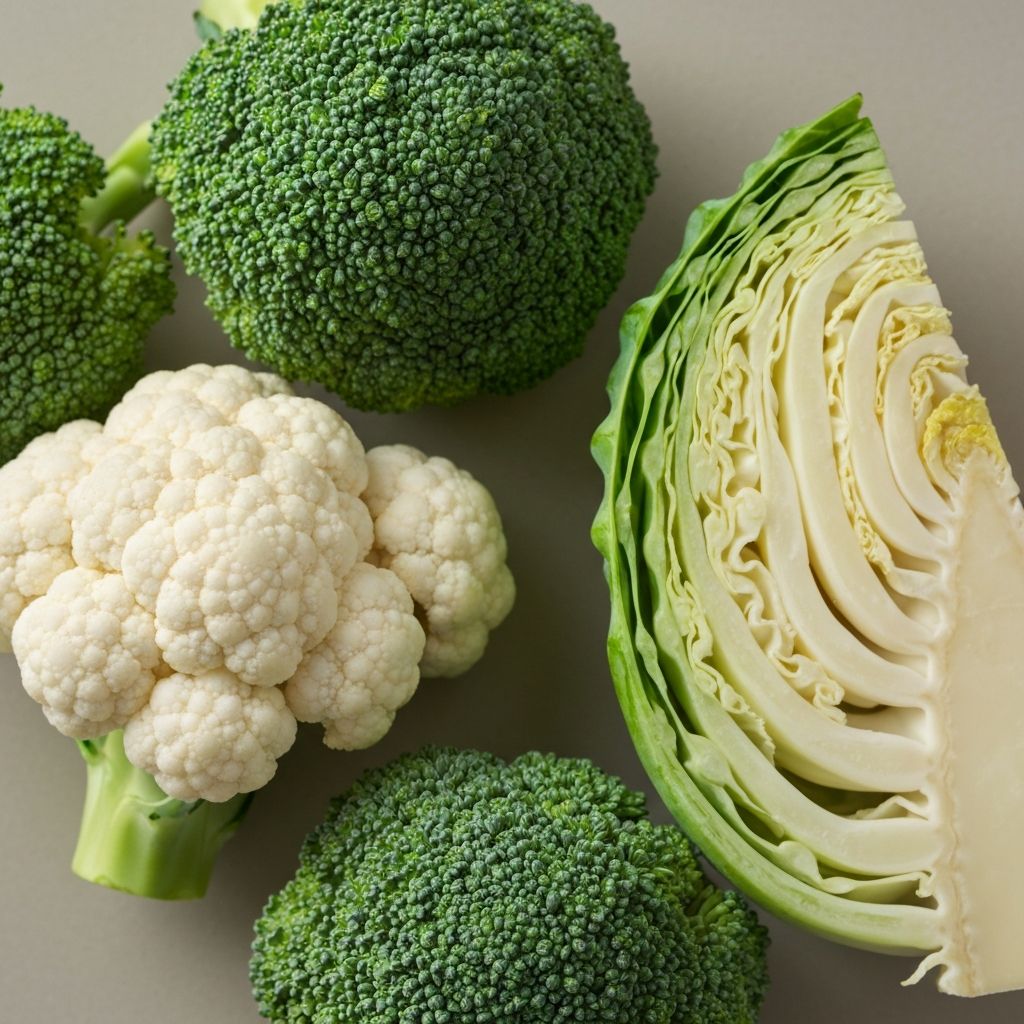
The Brassicaceae family includes broccoli, cauliflower, cabbage, Brussels sprouts, kale, and related species. All members of this family share distinctive four-petalled flower patterns (hence the botanical designation). These vegetables represent a nutritionally significant category within the low-energy-density spectrum, characterized by specific compositional patterns and structural arrangements.
Broccoli Characteristics
Broccoli comprises flowering head clusters attached to thick stalks. The head consists of densely packed floral buds, each a miniature flower at an immature development stage. This clustered floral structure creates extensive surface area within a relatively compact form. Raw broccoli contains approximately 89% water and approximately 34 kcal/100g. The dense floret arrangement and high cellular surface area create distinctive structural properties.
Cauliflower Structure
Cauliflower displays a structure superficially similar to broccoli but with distinct cellular and compositional differences. Cauliflower florets remain white because they develop in darkness beneath enclosing leaves, lacking the chlorophyll present in broccoli. This developmental difference has minor nutritional consequences. Raw cauliflower contains approximately 92% water and approximately 25 kcal/100g—slightly lower energy density than broccoli due to marginally higher water content and lower carbohydrate concentration.
Cabbage Varieties
Cabbage varieties display layered leaf structures arranged in compact heads. Green and red varieties represent the most common types. Cabbage leaves are tightly packed, creating dense heads with minimal internal air space compared to lettuce. Raw cabbage contains approximately 92% water and approximately 25 kcal/100g. The layered structure creates substantial textural differences from leafy greens despite similar energy density values.
| Cruciferous Vegetable | Water % | kcal/100g | Protein g/100g | Structure Type |
|---|---|---|---|---|
| Broccoli | 89% | 34 | 2.8 | Floral clusters |
| Cauliflower | 92% | 25 | 1.9 | Floral clusters |
| Green Cabbage | 92% | 25 | 1.3 | Layered leaves |
| Red Cabbage | 92% | 31 | 1.4 | Layered leaves |
| Brussels Sprouts | 86% | 43 | 3.4 | Miniature heads |
Compositional Patterns
Cruciferous vegetables collectively display water content ranging from 86–92% and energy density from 25–43 kcal/100g within this family. Members with lower water content, such as Brussels sprouts (86% water, 43 kcal/100g), contain higher carbohydrate and protein concentrations. All cruciferous vegetables remain in the low-energy-density category despite their relatively higher values compared to leafy greens.
Discover More Vegetables
Learn about high-volume, low-density vegetables like cucumber and celery.
Read next article