High-Volume Low-Density Vegetables
Examination of cucumber, celery, and courgette—vegetables representing the extreme end of the water content and low energy density spectrum.
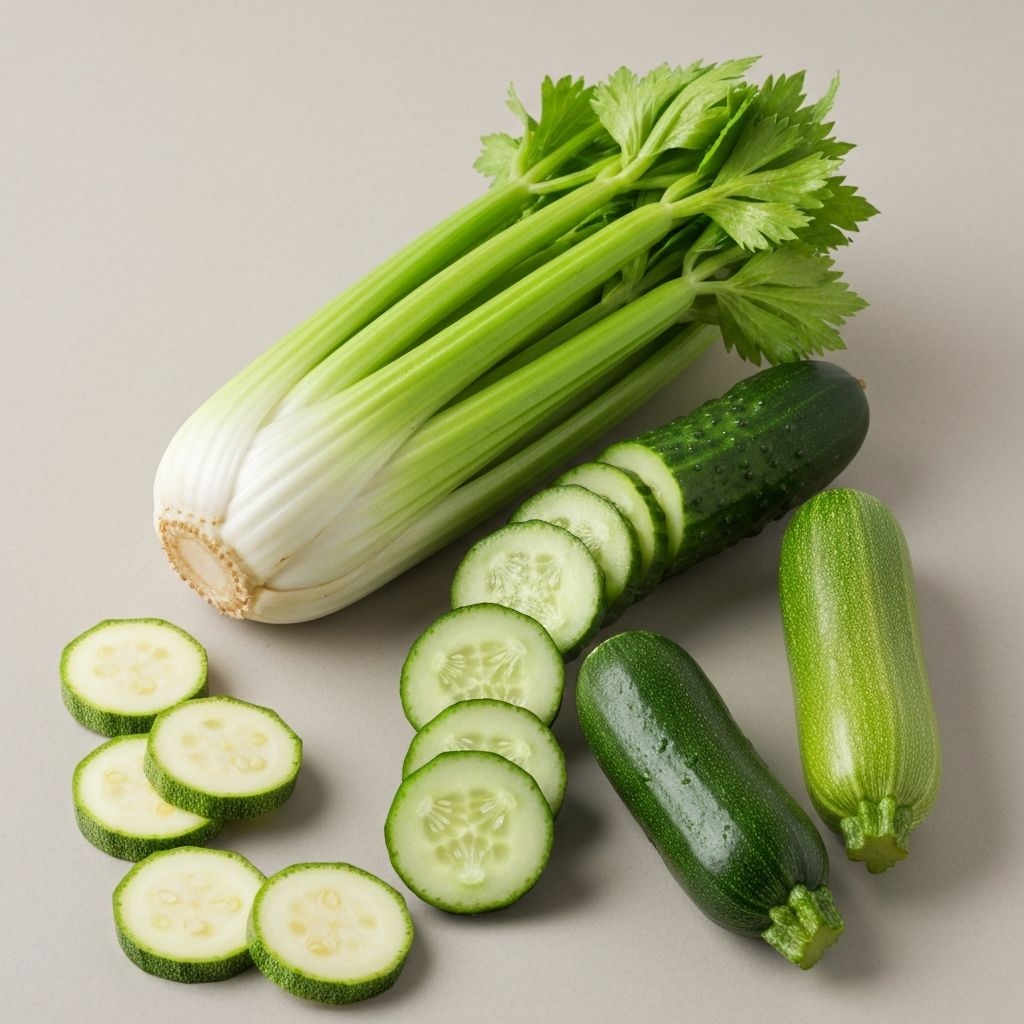
Vegetables at the Extreme End of Energy Density
Cucumber, celery, and courgette represent vegetables with the lowest energy density values among commonly available produce. These vegetables exceed 95% water content and contain approximately 15–17 kcal per 100 grams. Their exceptional water content and minimal carbohydrate concentration place them distinctly below the already low-density average of most vegetables.
Cucumber Structure and Composition
Cucumbers consist of exterior skin surrounding a central cavity containing seeds suspended in gelatinous material. The entire structure is approximately 96% water. Both the seed cavity and surrounding flesh are predominantly water with minimal solids. The cellular walls are thin and flexible, creating the characteristic crispness when water pressure (turgor) is maintained. Raw cucumber contains approximately 16 kcal per 100 grams, among the lowest of any vegetable.
Celery's Distinctive Architecture
Celery stalks comprise fibrous strands embedded in water-filled cellular tissue. The fibrous strands provide structural rigidity despite the exceptional water content. Raw celery contains approximately 95% water and approximately 16 kcal per 100 grams. The distinct fibre arrangement creates the characteristic stringy texture and structural rigidity. Unlike cucumber, celery maintains substantial structural integrity even when cellular turgor pressure is lost.
Courgette (Zucchini) Characteristics
Courgettes are botanically immature squash fruits harvested at early developmental stages. Like cucumber, they contain central seed cavities surrounded by flesh composed primarily of water. The skin is thin and edible. Raw courgette contains approximately 95% water and approximately 17 kcal per 100 grams. Structurally, courgettes closely resemble cucumbers in their cellular composition, though their grow patterns, skin texture, and size characteristics differ substantially.
| Vegetable | Water % | kcal/100g | Carbs % | Key Structure |
|---|---|---|---|---|
| Cucumber | 96% | 16 | 3.6% | Central seed cavity |
| Celery | 95% | 16 | 3.0% | Fibrous strands |
| Courgette | 95% | 17 | 3.5% | Central seed cavity |
Textural Characteristics Derived from Structure
Cucumber and courgette achieve crispness through thin-walled cellular structures and substantial water content creating cellular turgor pressure. This combination produces the characteristic snapping sensation and fresh texture when consumed. Celery achieves textural properties through a different mechanism—the fibrous strands resist breakage even as surrounding tissue is relatively soft, creating a distinctive stringy, crisp quality that differs from cucumber's uniform crispness.
Explore Additional Vegetables
Learn about other commonly available low-energy vegetables.
Read next article